
Employment of Football Players from Outside the European Union in Poland
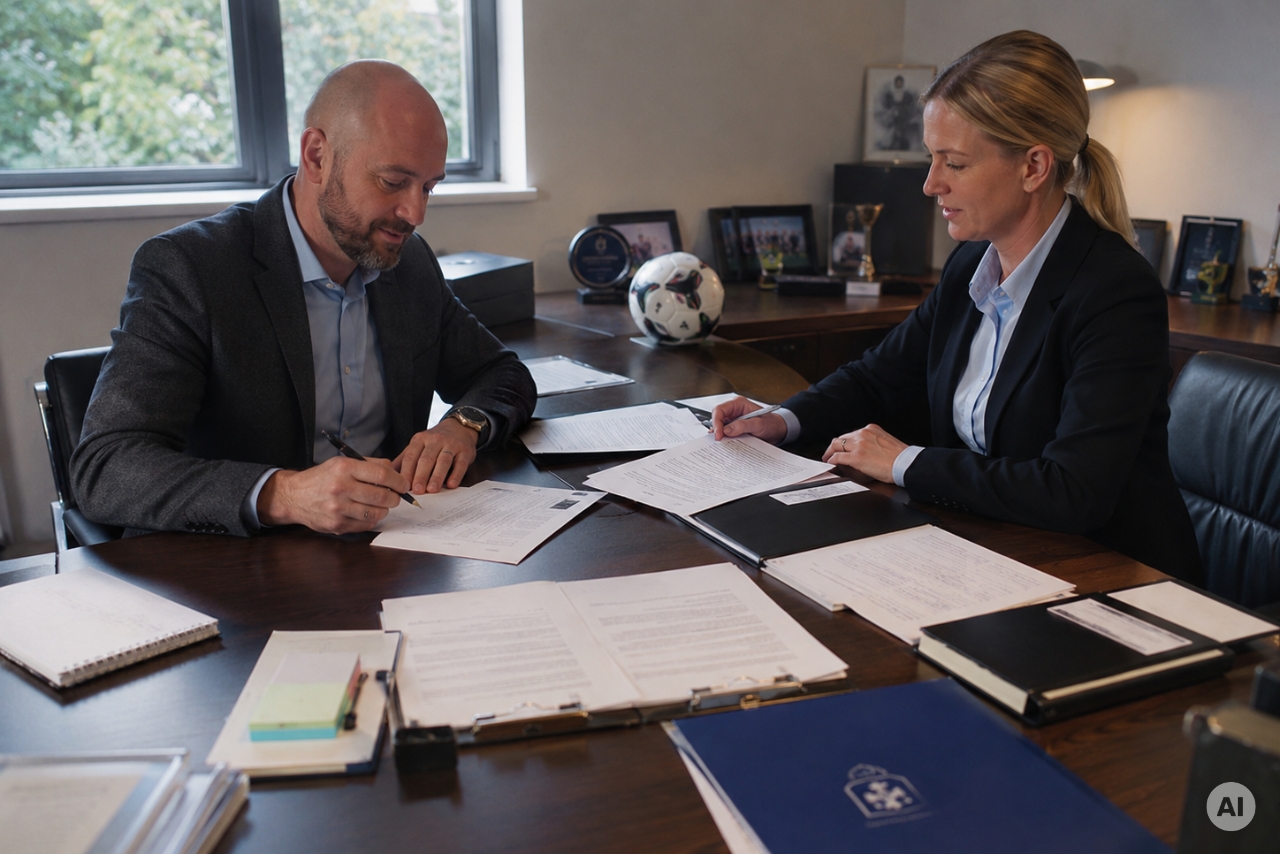
How are football players from outside the European Union hired in Poland?
In our previous article, we discussed why a B2B contract with a football player can be an attractive solution and is commonly used by clubs in Poland’s top league. However, in the case of players from outside the European Union, civil law contracts concluded with the player as a natural person not conducting business activity (so-called “zlecenie”) are much more common. This is primarily due to regulations concerning foreign nationals and the associated difficulties in establishing a business in Poland.
B2B vs. a Contract with a Non-Business Owner – What’s the Difference?
In the B2B model, the player acts as a business owner. The club then enters into a contract with a natural person conducting business activity. The player provides services to the club as part of this business activity and issues invoices. The player then independently settles all taxes and other public-law obligations.
In contrast, when employing a person who is not self-employed, the club withholds income tax and social security contributions in accordance with Polish law. Later (in the annual tax return), the player may be entitled to a partial refund of overpaid tax or may owe additional tax, which they will have to pay on their own; however, part of the tax will already have been paid by the club.
Importantly, player contracts in Poland are not employment contracts. In Polish practice, a player’s contract is often structured as a contract for the provision of services, to which the provisions governing contracts of mandate apply mutatis mutandis pursuant to Article 750 of the Civil Code.
A non-EU foreign national cannot simply start a business
The most significant difference arises under the law governing foreigners.
A third-country national does not automatically have the same right to conduct business in Poland as a Polish citizen or an EU citizen. A foreign national’s ability to operate a sole proprietorship depends primarily on their residence status.
Polish regulations specify certain categories of foreign nationals who may conduct business on the same terms as Polish citizens. For other foreign nationals, the options are more limited.
Let’s imagine a player from Brazil, Nigeria, Argentina, or Ghana who signs his first contract with a Polish club. If his stay in Poland is related to fulfilling his contract with the club, simply signing a B2B contract does not grant the player the right to operate a sole proprietorship in Poland.
In the case of a typical international transfer from outside the European Union, a player will usually face difficulties registering their business, which is why these players are most often employed without registering a business. This makes it much easier to legalize a foreigner’s stay and work in Poland.
Public Law Obligations
Individuals providing services under a contract of mandate are generally subject to mandatory pension and disability insurance, and the relevant regulations also set forth rules regarding health insurance. However, settlements with ZUS also depend on other factors. Sometimes, clubs employ non-EU players under two contracts with two different entities—this allows for lower ZUS contributions to be paid per contract. It is important to note that this practice is prohibited if the employment under two separate contracts, as described above, is merely a pretense and serves only to reduce the public-law contributions owed.
In the case of a foreign national, one must also take into account their tax residency, certificate of residency, and the applicable double taxation treaty. Typically, however, the player’s tax residency is in Poland. The club then withholds a 12% advance on income tax from the player’s income. At the player’s express request, once a higher tax threshold is exceeded, the club may continue to withhold a 32% advance on income tax—thereby allowing the player to avoid having to pay additional tax after the annual tax settlement.
For players who do not have tax resident status in Poland, a flat-rate tax of 20% of their income will be withheld.
Summary – Employment of Football Players from Outside the European Union in Poland
Non-EU football players are generally not employed on a B2B basis because this involves significant administrative difficulties related to a foreign national registering a business in Poland. A foreign national from a third country does not automatically have the right to operate a sole proprietorship in Poland. This possibility depends on their residence status in Poland.
Therefore, in the case of a foreign football player, a contract for the provision of sports services—to which the provisions governing contracts for services apply mutatis mutandis—is usually a much simpler solution for both clubs and players. However, this typically results in a higher tax burden associated with such a contract.
This does not mean, however, that a B2B arrangement is out of the question. If a player has the appropriate residency status and can legally operate a business, a B2B model may be permissible. Such situations are rare in practice, however, and are usually reserved for non-EU players who have been playing in Poland for years.
FAQ
Yes, but not in every case. A non-EU foreign national does not automatically have the right to operate a sole proprietorship in Poland. The possibility of using a B2B model depends primarily on the player’s residence status. In practice, this solution is more common among players who have been living and playing in Poland for a longer period of time.
The main reason is the difficulty non-EU nationals may face when registering a business in Poland. In the case of a typical international transfer, a simpler solution is to conclude a sports services agreement with the player as an individual, to which the provisions on mandate contracts apply accordingly. This also makes it easier to legalise the player’s stay and work in Poland.
If the player enters into a contract as an individual who does not conduct business activity, the club is responsible for withholding advance income tax payments and paying social security contributions in accordance with the applicable regulations. The method of tax settlement also depends, among other things, on the player’s tax residency, tax residence certificate and the relevant double taxation treaty.
Zbrodnia VAT
Zbrodnia VAT
We also encourage you to explore our other publications.